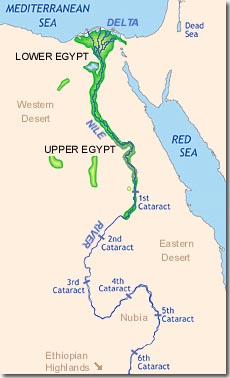
In some places, where the Nile fails to erode more resilient
rock, the water forces itself through the hard rock to form great
tumbling rapids called cataracts.
The Nile cataracts have always restricted boat travel
between Egypt and Nubia (and the Ethiopian Highlands beyond).
The cataracts define river segments where granites and
diorites come down to the edge of the Nile. The floodplain is narrow
or non-existent here and agricultural development correspondingly
limited.
These two reasons - navigation obstacles and restricted
floodplain - are why this part of the Nile has always been thinly
populated.
There are six 'classical' cataracts but ten in all.
The First Cataract at Aswan forms the natural and traditional boundary
between Egypt to the north and Nubia in the south. Throughout Egyptian
history, various pharaohs attempted to push Egypt's fortified borders
up the Nile past successive cataracts into Nubia.