|
|
|
 |
|
 |
|
THE WEALTH OF THE NILE -- THE CULTURE AND ECONOMY OF ANCIENT EGYPT
|
|
 |
THE POPULATION
|
 |
|
 |
Although Egypt straddles the junction between Asia and Africa, the
genetic and cultural roots of the Egyptian people lie in Africa. Skull
measurements and DNA tests indicate a Northern Sudan/Upper Nile origin.
As the Sahara dried, the ancestors of the Egyptians flocked to the
Upper Nile branches and then down the river to the Delta. The Predynastic
Egyptians lived in relative isolation from the rest of the world,
and we see genetic continuity all the way into Middle Kingdom times.
Infiltration from outside populations into the Nile Valley began in
the 2nd Intermediate Period, and people
from Nubia, Libya and the Middle East turned Egypt into a 'melting
pot' of genes and skin tones.
Today we know that the idea of 'race' is genetically irrelevent,
and so too the discussion of what 'race' the Ancient Egyptians were.
Life in a subtropical desert environment undoubtedly gave the Egyptians
darker skin tones, and so they were for the most part what we call
'black' (or at least, very tan!)
|
|
POPULATION COUNT
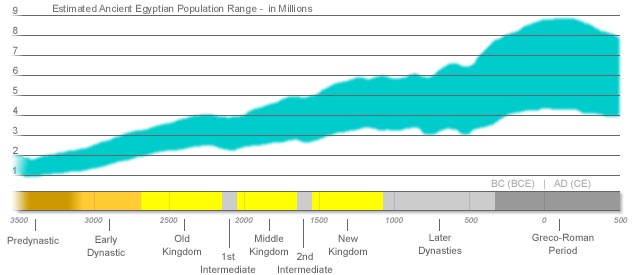
The population count of Egypt under the first dynasties was possibly
between 1 and 2 million inhabitants. It slowly rose until the end of
the Old Kingdom. The sustained drought and famines of the 1st
Intermediate Period caused a serious population decline. Other declines
probably occured in the chaos and warfare of the 2nd Intermediate Period
and the foriegn invasions of the Later Dynasties Period.
|
|
|
|
Estimates of the ancient Egyptian population are, of course, educated
guesses. The urban population in the Greco-Roman Period amounted to 37%,
making Egypt the most urbanized society at the time.
IMMIGRANTS
Over the centuries Egypt had a steady immigration of foriegners, often
driven by war, drought or overpopulation from their homelands:
|
|
- Nubians during the the First Intermediate Period.
- Canaanites and probably Israelites (collectively called Asiatics)
many times after Middle Kingdom times.
- Enslaved peoples during the expansionary phases of the empire in
Asia and Africa (Middle and New Kingdom)
- Phoenician merchants peacefully traded in Lower Egypt since early
times. Their ships carried much of Egypt's trade.
- The Hyksos, a Middle Eastern people, conquered Lower Egypt during
the Second Intermediate Period (later expelled).
- The 'Sea Peoples' infiltrated in the Later Dynasties Period, but
most were repelled.
- Libyans settled in the eastern Delta and Nubians in Upper Egypt
in the Later Dynasties Period.
- Jews, led by Jeremiah, found a safe haven in Egypt after the Assyrian
conquest of Judah.
- The Assyrian and Persian conquerors remained content with controlling
Egypt from afar.
- Macedonians, Greeks & Romans in the Greco-Roman Period. They
built new cities; usually didn't merge with native Egyptians.
|
|
|
These immigrants probably added little to the population size. The numbers
of these migrants and conquerors were not very large compared to the
indigenous Egyptian population, and they were mostly absorbed over the
centuries after having had separate identities for a few generations.
For individual foreigners, integration into Egyptian society wasn't
too difficult. especially for merchants, soldiers, artisans or talented
royal servants. Many officials employed in the royal bureaucracy during
the Later Dynasties Period had Asiatic names. They don't seem to have
suffered much discrimination, even if they retained some of their native
culture.
|
|
AGE DEMOGRAPHICS
Like all people living without modern medicine and public hygiene, the
ancient Egyptians usually died young. Life expectancy was less than
40 years. Infectious and water-borne diseases were the chief killers.
Ancient physicians lacked antibiotic knowledge,
of course, and could only alleviate symptoms. In times of famine or
war even more died, especially the old, sick and very young.
We would be struck by the youthfulness of the ancient Egyptians - rich
and poor, royalty and peasantry. Surveys of cemetaries and tombs indicate
that the main age of death was between 20 and 40 years, mostly peaking
between 20 and 30. Infant mortality was high, at least 30%. Social class
or ethnicity apparently didn't matter.
Nevertheless, some beat the odds. The 6th Dynasty pharaoh Pepy II (2278-2184)
famously ruled for 94 years. We have records of some people living into
their 90s, but such longevity was the exception.
DISTRIBUTION
The ancient Egyptians settled in three main clusters in the Nile Valley:
Upper Egypt between Thebes and the First Cataract, in the Faiyum oasis-swamp
around Lake Moeris and the majority in Lower Egypt in the Delta. |
|
|
The majority of ancient Egyptians - probably more than 90% - lived on
the land in mostly self-sufficient farming villages on the Nile flood
plains. They worked as tenant farmers or as laborers on the estates
of the pharaohs, nobility or priesthood. Officials, priests, traders
and craftsmen lived mostly in the cities along the Nile, and took advantage
of the cheap and easy movement of goods and services by boat.
|
|
Home
| Nile Valley | Dynasties
| Wealth | Divinity
| Temples | Hieroglyphs
| Mysteries
|
|
|
|
|
|
|
|
|