 |
||||||
 |
||||||
 |
||||||
|
 |
|
 |
|||
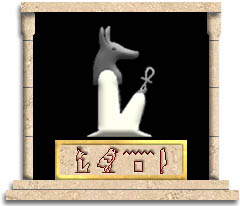
Translation -- "The Royal Child" |
||||||
|
||||||
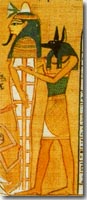
Over time Osiris's popularity would absorb much of Anubis's nature, causing Him to be written into the myths as Osiris's son by Nephthys (or alternately Set's son or Isis's son). Anubis was relegated to the role of embalmer and overseer of the funerary processes. Anubis was also the guide for the deceased soul. In Egyptian iconography, Anubis can be seen leading the deceased person into the Hall of Double Truth, where He then weighs the deceased's heart against the Feather of Ma'at. Masks of Anubis were routinely worn by the priest officiating at the funeral and the 70-day mummification process. The images seen of Anubis wrapping bandages, pouring oils or embracing the coffin are generally not actually images of the God Himself, but of His servants doing His work. In later times Anubis would be syncretized with Greek Hermes and seen as a psychopompos or "Messenger of the Gods". |
 |
|||||