 |
||||||
 |
||||||
 |
||||||
|
||||||
 |
THEBES -- WASET -- DEBA
-- THEBAI |
 |
||||
 |
|
|||||
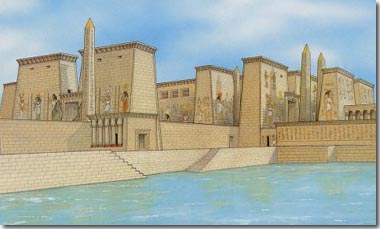
Today the site of Thebes includes areas on both the eastern bank of the Nile, where the massive temples of Karnak and Luxor stand, and the western bank, with the Valley of the Kings and the large private and royal cemeteries and funerary complexes. Thebes-Waset began as the main city of the 4th Upper Egyptian nome. It was close to both Nubia and the eastern desert, with their valuable mineral resources and trade routes. Waset was little more than a provincial town in the Old Kingdom. Though some tombs from the 3rd to 6th Dynasties have been found, it is not clear that there was an actual Old Kingdom settlement here. The royal residence and tombs, as well as most of the tombs of the court and government nobles at this time, were primarily built at Saqqara near Memphis in Lower Egypt. According to the current historical record, Thebes did not come into its political strength until the First Intermediate Period. A large number of private inscriptions from this chaotic period indicate that the nome rulers (provincial governors) of Koptos, Moalla, and Thebes were prominent at this time. The Theban nome rulers were of the family Inyotef, who before long began to write their names in cartouches. The second of this name boldly called himself the 'King of Upper and Lower Egypt', though his power didn’t extend much further than the general Theban region. Eventually the Theban ruler Mentuhotep II took control of the Nile Valley and is credited with again uniting all Egypt under one ruler. He began the 11th Dynasty of what we call the Middle Kingdom. Mentuhotep II ruled for 51 years, and built the temple at Deir el-Bahri that most likely served as the inspiration for the later and larger temple built next to it by Hatshepsut in the 18th Dynasty. Amenemhat I of the 12th Dynasty decided to move his capital north to a new site called Itjtawy and Thebes lost political power. Although the capital had moved, Thebes took on a new role as the religious center of Egypt, since its god Amun was 'promoted' to principal state deity. The oldest remains of a temple dedicated to Amun date to the 12th Dynasty reign of Senusret I (1956-1911). The core of this Middle Kingdom building lies in the heart of the current temple. The Theban apex came during the 18th Dynasty of the New Kingdom. Its
temples were the most important and wealthiest in the land, and the
tombs on the west bank were among the most luxurious Egypt ever had
seen. Thebes became synonymous with extravagant wealth, collected by
the Pharaohs in their expeditions south to the vast lands of Kush in
Nubia, and to the north in Canaan, Phoenicia, and Syria. |
||||||
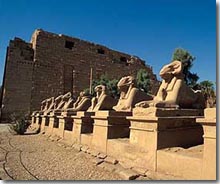
In those days, no other city in the world could match Thebes in military power or beauty. Much of the palatial or residential areas of the city have not been excavated, but there is every reason to believe that a sublime beauty was to be found there: ancient Egyptian pictures of houses, gardens, fields, palaces and feasts offer a furtive glimpse of this 'paradise-on-the-Nile'. The center of the city during the New Kingdom and Later Dynasties Period stretched between the major temples of Karnak to the north and Luxor to the south. The Avenue of Sphinxes connected them. The area is now almost entirely covered by the modern city of Luxor. During the 3rd Intermediate & Later Dynasties Period, the High Priest of Amun formed a counterbalance to the 21st and 22nd Dynasty kings who ruled from the Delta. Theban political influence slowly receded during this time. |
 |
|||||
|
Though ruined, Thebes did not forfeit its importance; rather it was integrated into a wholly commercial network of land, fluvial, desert and maritime routes that were established when the Persians conquered Egypt in 525 BC and linked it to their vast empire. The 'tourist trade' allowed the city to live off its past glories. No rich tombs were hewn in the western mountains any more, but rather, the whole city was considered as a mausoleum, and venerated as such. Even in decay, the Greek historian Herodotus was able to speak of the "One Hundred Gates of Thebes". Alexander the Great came toThebes and had an extension built at the Temple of Amun. Roman travelers met the last few Theban priests, some still versant in hieroglyphics. From then on, the grandeur of Thebes existed only spiritually, rather than seen by open eyes. Christian Coptic monks found it interesting to set their monasteries amidst the several ancient monuments.
|
||||||
Home | Nile Valley | Dynasties | Wealth | Divinity | Temples | Hieroglyphs | Mysteries
|
||||||