 |
||||||
 |
||||||
 |
||||||
|
||||||
 |
THE GREAT PYRAMID |
 |
||||
|
 |
|||||
|
||||||
 |
|
|||||
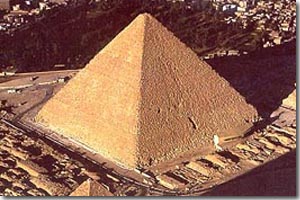
Herodotus was told by his Egyptian guides that it took twenty years for a force of 100,000 oppressed slaves to build the pyramid. Stones were lifted into position by the use of immense machines. The purpose of the structure, according to Herodotus's sources, was as a tomb for the Pharaoh Khufu (whom the Greeks called Cheops). Herodotus claimed that the outer casing was covered with "writing" or "symbols" of a language unknown to the Egyptians. We don't know how much of Herodotus' account we can trust. After all, he wrote 20 centuries after the Pyramid was built. One thing was certainly not true - that the builders were slaves. Archeologists have found the "work camps" of the builders, and they were well provided for. It makes sense - every year the Nile flooded, and for a month or two there was nowhere to live and nothing to do until the waters receeded. So the pharaohs gave the people a home and a job. Current theories center around huge canals, giant ramps, and/or counter-weighted cranes (huge versions of the waterdippers used even today on the Nile). But none of these offer a full explanation for this stupendous engineering feat. New theories concerning the origin and purpose of the Great Pyramid have been proposed . . . astronomic observatories . . . a center of cult worship . . . geometric structures constructed by a long-gone, unknown civilization . . . even extraterrestrial-related theories have been proposed. But there is little evidence for any of these. HOWEVER: At first glance, the sides of the Giza Pyramids, stripped of most of their smooth outer casing during the Middle Ages, look like regular steps. These are actually the courses of backing stones, so called because they once filled in the space between the pyramid core and outer casing. However, a closer examination reveals that the steps are not at all regular. In fact, rather then regular, modular, squared blocks of stone neatly stocked, there is considerable "slop factor", even in the Great Pyramid of Khufu. Not only are the backing stones irregular, they are also progressively smaller toward the top. Behind the backing stones, the core stones are actually even more irregular. We know this because, in the 1830s, Howard Vyse blasted a hole in the center of the south side of Khufu's's Pyramid while looking for another entrance. This wound in the pyramid can still be seen today, and in it, we can see how the builders dumped great globs of mortar and stone rubble in wide spaces between the stones. Here, there are big blocks, small chunks of rock, wedge shaped pieces, oval and trapezoidal pieces, as well as smaller stone fragments jammed into spaces as wide as 8.5 in/22 cm between larger blocks.
|
||||||