|
|||||||||
 |
|||||||||
 |
|||||||||
|
|||||||||
 |
INSIDE THE GREAT PYRAMID |
 |
|||||||
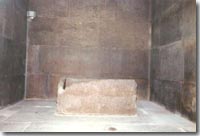
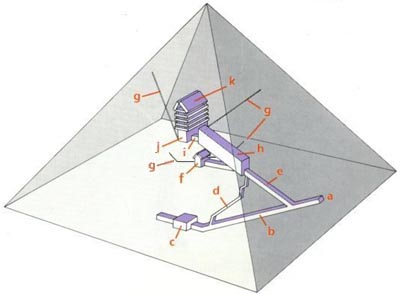
Most Egyptologists accept the theory that the Great Pyramid was just the largest of a tradition of tombs made for the Pharaohs of Egypt. If so, what happened to Khufu's mummy and treasure? Nobody knows. Extensive explorations continue to search for other chambers or passageways. One must wonder if, perhaps in this one case, the King and his architects out-smarted both ancient thieves and modern archaeologists and that somewhere in, or below, the last wonder of the ancient world, rests Khufu and his sacred gold. The Great Pyramid's compelling geometric form conceals a complex system of internal passages, chambers, shafts, and other features found in no other pyramid. Notable among these are the King's Chamber and its Granite Coffer (below) and the Queen's Chamber and its Niche. |
 |
||||||||
|
|
|
|||||||
The King's Chamber has two shafts, each about 5 inches in diameter which connect to the exterior. The Queen's Chamber has two which stop short of the walls of the chamber and do not penetrate completely to the exterior. The cross section of these shafts are sometimes oval, sometimes domed, and sometimes rectangular. One bends left and right to avoid the Grand Gallery. There must have been good reasons for these shafts since their angled
construction appears to have been problematic, requiring considerable
extra effort on the part of the builders of the Great Pyramid. |
|||||||||
 |
|
 |
|||||||
|
|||||||||
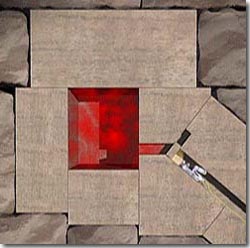
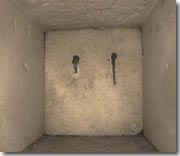
These "stone doors" are certainly not just ornaments. They must have a function and hide something behind them (above left). The doors discredit the theory that the 'air shafts' were built for the dead king Khufu to slip through on his journey to the afterlife, as was previously believed. The doors should be opened to help us answer the many unsolved questions about the Great Pyramid and the ancient Egyptians - and who knows what else might be found . . . |
|||||||||
There are other mysterious spots in the Great Pyramid. In the King's Chamber all of the stone joints are very tight except in the lower eft-hand corner of the west wall. Here the joints are larger than normal and covered by mortar. This is a strong indication of an opening to another chamber or passage. The Egyptian government has refused requests for further exploration. In 1986 a French team using microgravimeter equipment detected small hidden cavities behind the west wall of the horizontal passage to the Queen's Chamber. They were permitted to bore a 1" diameter hole and found a cavity filled with sand. They were not permitted to dig or tunnel for further investigation. The cavities in the horizontal passage to the Queen's Chamber correspond to two floor stones in this passageway with joints perpendicular to the rest of the joints in the floor stones. This type of indicator can also be found at the junction of the descending and ascending passageways. About 70 feet along the north side of the Great Pyramid from the northeast corner is a 4x10 foot stone sunk into the foundation at an angle. The joints are very precise and this is the only stone in the foundation perimeter not at a right angle to normal construction. It would have been covered by the mantle but is now accessible since the mantle is gone. It is very likely an entrance. No further investigation has been done. In 1987 a Japenese team used an electromagnetic wave method to search for cavities. They identified a cavity under the horizontal passage to the Queen's Chamber about 1.5 meters beneath and extending for 2.5-3.0 meters in depth. They also identified a cavity behind the western part of the northern wall of the Queen's Chamber. They identified no cavities within the King's chamber, possibly due to the denser granite walls. |
|||||||||