 |
||||||
 |
||||||
 |
||||||
|
||||||
 |
KARNAK -- IPET-ISUT |
 |
||||
 |
|
|||||
The key difference between Karnak and most of the other temples and sites in Egypt is the length of time over which it was developed and used. Construction work began in the 20th century BC. More than 30 pharaohs over a span of 2,000 years contributed to the buildings, enabling it to reach a size, complexity and diversity not seen anywhere on earth. Few of the individual features of Karnak are unique, but the size and number of features is overwhelming. The four main parts, enclosed by enormous brick walls, are;
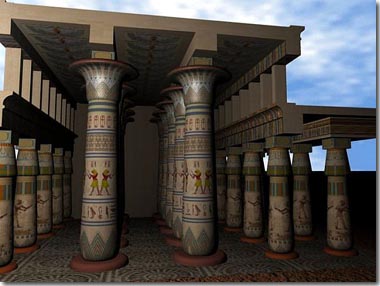
In addition there are also a few smaller temples and sanctuaries located outside the enclosing walls of the four main temples, as well as several avenues of ram-headed sphinxes connecting the Precinct of Mut, the Precinct of Amun-Ra and Luxor Temple. The sprawling Karnak complex is famous for its main Hypostyle Hall with 134 massive columns. One can wander for hours amongst the ruins. Starting at the first pylon, one walks back through time to the earlier constructions toward the rear. The oldest remains of a temple dedicated to Amun date to the reign of the the 12th Dynasty pharaoh Senusret I (1956-1911 BC). The core of this Middle Kingdom building lay in the heart of the current temple, behind the sanctuary. Its walls were constructed of limestone which were later removed for use elsewhere. So now there is an empty space between the sanctuary and the Festival hall of Tutmosis III. However, the small so-called "White Chapel" shrine built by Senwosret I has been rebuilt and stands in the Open Air Museum at Karnak. The Opet Festival In ancient Egypt, the power of the god Amun of Thebes gradually increased during the early New Kingdom, and after the short persecution led by Akhenaten, it rose to its apex. In the reign of Ramesses III, more than two thirds of the property owned by the temples belonged to Amun, evidenced by the stupendous buildings at Karnak. This vast complex was built and enlarged over a thirteen hundred year period.
|
||||||
|
||||||
|
|
||||||
Home | Nile Valley | Dynasties | Wealth | Divinity | Temples | Hieroglyphs | Mysteries
|
||||||