 |
|||||
 |
|||||
 |
|||||
|
|||||
 |
ALEXANDRIA |
 |
|||
 |
|
||||
The second largest city in Egypt, Alexandria, known as "The Pearl of the Mediterranean", has an atmosphere that is more Mediterranean than Middle Eastern ; its ambience and cultural heritage distance it from the rest of the country although it is actually only 225 km. from Cairo. by The setting for the stormy relationship between Cleopatra and Mark Antony, Alexandria was also the center of learning in the ancient world. But ancient Alexandria declined, and when Napoleon landed, he found a sparsely populated fishing village.The setting for the stormy relationship between Cleopatra and Mark Antony, Alexandria was also the center of learning in the ancient world. But ancient Alexandria declined, and when Napoleon landed, he found a sparsely populated fishing village. They began with the new capital of Egypt --
From the 19th century Alexandria took a new role, as a focus for Egypt's commercial and maritime expansion. This Alexandria has been immortalized by writers such as E-M- Forster and Cavafy. Generations of immigrants from Greece, Italy and the Levant settled here and made the city synonymous with commerce, cosmopolitanism and bohemian culture. In the mid-100s AD, strife between Jews and Greeks in Alexandria brought massacres and riots.
Old Alexandria Dinocrates built the Heptastadion, the causeway between Pharos and the mainland. This divided the harbors into the Western and Eastern. The Eastern harbor was really where the old harbor from the Middle Ages was located. Of modern Alexandria, the oldest section is along the causeway which links what was once Pharos island with the mainland and includes the districts of Gumrok (the oldest dating to about the 16th century and known as the customs district) Anfushi, and Ras el-Tin (Cape of Figs). The latter two districts date to about the period of Mohammed Ali (1805-49). Collectively, these districts are known to westerners as the Turkish Quarter. They have had a number of ups and downs over the years, particularly due to the plague during the 17th century. The area forms somewhat of a T-shape, dividing the Eastern Harbor from the Western Harbor. This section of Alexandria is known to us more from books then what
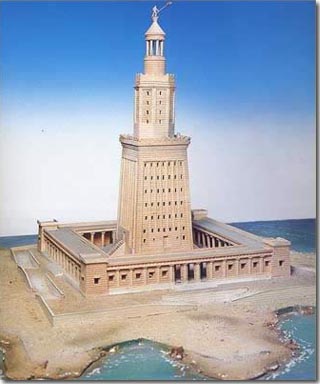
we may actually see in the area. Where the Pharos Lighthouse once stood,
is now occupied by the Fort of Quit Bay (1) out on the area that circles
up around the top of Eastern Harbor forming the eastern section of the
top of the T. Heading south from the Fort of Quit Bay, we come to the
stunning Abu El-Abbas Mosque (2). West of this is the Anfushi Tombs
(3), some of the oldest in Alexandria The Underwater Discoveries In the south east part of the harbor archaeologists have apparently found the Royal Quarters, including granite columns and fabulous statues, including one of Isis and a sphinx with a head thought to be that of Cleopatra's father. |
|||||
Home | Nile Valley | Dynasties | Wealth | Divinity | Temples | Hieroglyphs | Mysteries
|
|||||