Djoser's Step Pyramid was not just a tomb, but was a collection of
temples, pavilions, corridors, chapels, halls and storerooms. His
plan included fluted columns that were attached to the limestone walls,
which conformed to the walls in the palace. This preserved a link
with the past in the ancient styles of architecture.
Among his writings (once preserved in the Library of Alexandria)
the best known were medical journals. Greek physicians such as Galen
held him in high honor. During the Roman period the emperors Tiberius
and Claudius and had inscriptions praising Imhotep carved on the walls
of their Egyptian temples.
Imhotep existed as a mythological figure in the minds of most scholars
until the end of the nineteenth century when he was established as
a real historical personage.
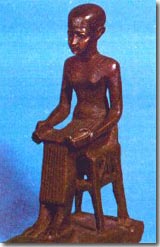
Revered as a god, a patron of scribes, a sage and leader, today we
consider Imhotep the world's first true architect.