 |
|||||||
 |
|||||||
 |
|||||||
|
|||||||
 |
EDFU -- WETJESET-HIW --
DJERBA -- ETBO -- APOLLINOPOLIS MAGNA |
 |
|||||
 |
|
||||||
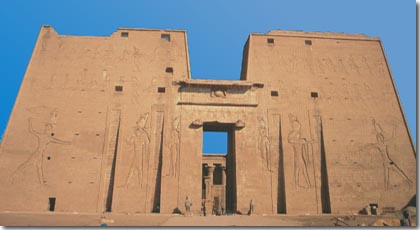
It was Horus, who, upon reaching adulthood, avenged Osiris' death by defeating and castrating Set and becoming the divine prototype of the pharaoh. (The myth perhaps reflects Early Dynastic Period warfare among the nome-states of Upper Egypt) The sandstone temple dedicated to Horus (above), is the most
complete and best preserved of all the temples of Egypt. The Ptolemaic
Dynasty built it on the site of a New Kingdom temple. In the Greco-Roman
Period Edfu was called Apollinopolis Magna, since by then Horus
was identified with the Greek god Apollo. |
|||||||
Edfu was the Predynastic capital of the 2nd nome of Upper Egypt. It had an excellent geographic location and an elevated floodplain, attractive to settlers. Edfu served as an important regional center in the Old Kingdom, partly due to large areas of fertile land in the nome, and partly to the fact that Edfu was situated near the frontier between Egypt and Nubia. Edfu was was also a starting point for desert routes leading to the Kharga Oasis in the Western Desert, and to the mines of the Eastern Desert and the Red Sea coast beyond. There is a tradition that Imhotep, the vizier and architect who designed the Step Pyramid of Djoser at Saqqara, designed the first stone temple at Edfu. Little is known of this temple today, and none of its remains have been found, but it was dedicated to Horus and Hathor of Dendera. |
 |
||||||
As the Old Kingdom drew to a
close, local nome governors took on greater
power in their areas, away from the central royal authority. During
the First Intermediate Period, the 10th
Dynasty from Herakleopolis in the north fought with the 11th Dynasty
from Thebes in the south. But the nome rulers of Edfu maintained their
independence, possibly by playing off one dynasty against another, and
by generating enough food to avoid the chronic famines of the time. |
|||||||
 |
|
||||||
The main building was the great Temple of Horus Behedti. It was begun in 237 BC, by Ptolemy III Euergeter I (246-222 BC). In 206 BCE, work was halted by an insurrection, during which two chiefs from the Theban area declared themselves independent of Ptolemaic rule (history repeating itself, perhaps). The temple was formally dedicated in 142 BC by Ptolemy VIII Euergetes II and his wife Cleopatra II.
|
|||||||
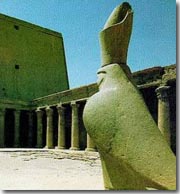
| _~~~~~ No larger remains dating earlier than the 5th Dynasty have been found at Edfu. Its most ancient cemetery comprised the mastabas of the Old Kingdom as well as later tombs, and covers the area southwest of the precinct of the great temple of Horus. Before the beginning of the New Kingdom, the necropolis was transferred to Hager Edfu, to the west, and then in the Late period to the south at Nag’ el-Hassaya. The entire area was called Behedet. The god Horus was herein worshipped as Horus Behedet. One of these mastabas belonged to a man named Isi, who was the "great chief of the Nome of Edfu" in the 6th Dynasty. Isi lived during the reign of King Djedkare Isesi of the Fifth and into the reign of Pepi I of the Sixth Dynasties. He was an administrator, judge, chief of the royal archives and a "Great One among the Tens of the South. Isi later became a living god and was so worshipped during the Middle Kingdom. As the Sixth Dynasty and the Old Kingdom drew to a close, local regional governors and administrative nobles took on a larger power in their areas, away from the royal central authority. During the Tenth Dynasty, in the First Intermediate Period, Thebans from the south fought with the Herakleopolitan rulers of the north. A man named Ankhtify, the governor of the third nome of Upper Egypt and a follower of the Herakleopolitan kings, held among other titles that of "Great Chief of the nomes of Edfu and Hierakonpolis." He became governor of Edfu after he had defeated his predecessor in that regard, one Khuy, who had been loyal to the Thebans. And in his autobiography writes that there was famine throughout Upper Egypt. But he refused to see anyone die of hunger in his province, and "brought life to the provinces of Hierakonpolis and Edfu, Elephantine, and Ombos!" Later on, Ramesses II and Shabaka, among other New Kingdom monarchs, built at Edfu. But its most famous (for us today at least) monumental structure, its great Temple to the god Horus, was built during the Ptolemaic period. The Temple at Edfu was in fact the first new temple commissioned by the Ptolemies. The Ptolemies were great builders in Egypt, these descendants of one of Macedonian Alexander’s generals. They left as their architectural legacy the great Temple of Isis at Philae, the temple of Hathor at Dendera, the Temple of Horus at Edfu, and others. At Edfu, Horus was worshipped as the falcon Horus of Behdet. The Temple was called Mesen, The Place of the Harpoon, the Mansion of Ra, Nedjem-Ankh, Pleasant to Live In, the Window of the Falcon, the Shrine of Horus, and Wetjeset, the Place of Extolling the God. The main building was the great Temple of Horus Behedti. It was begun on August 23, 237 BCE, by Ptolemy III. In 206 BCE, work was halted by an insurrection, during which two chiefs from the Theban area declared themselves independent of Ptolemaic rule (history repeating itself, perhaps). The temple was formally dedicated in 142 BCE by Ptolemy VIII Euergetes II and his wife Cleopatra II. Closer to the eastern tower of the temple pylon, the remains of another pylon have been unearthed dating to the Ramesside period. This may have formed part of one of the predecessors of the extant temple. The temple precinct consisted of the temple itself, within its own enclosure wall, and other subsidiary temples, small chapels, workshops, storehouses, and dwellings. Most of these, including the sacred lake and slaughterhouse, have now either been destroyed or lay under the houses of the present town. South of the temple are the ruins of the mammisi, or birth-house, a temple in which the birth of the god Harsomntus was celebrated. The scanty architectural remains to the east probably belong to the temple of the sacred falcon. The twin towers of the great entrance pylon of the temple were planned as perfect mirror images of each other, both in their construction and in the rather curiously rendered scenes carved on their surfaces. Two statues of Horus as a falcon flank the entrance gate, and behind the pylon, at the base of the walls on either side of the entrance are scenes depicting the Feast of the Beautiful Meeting, in which Horus was united with Hathor of Dendera. The outer hypostyle hall contains twelve columns inside and are the highest of the whole temple. In the eastern part the library was installed in a small chamber and two catalogs inscribed on the walls list the titles of every book held therein. Some of these scroll-books included "The book for performing the ritual for the protection of the city, of the houses, of the White Crown, of the year," the roll book of temple guards, and Information about the regular appearance of the sun and moon and the periodical return of the other stars. The small chamber in the western part of the façade was dedicated to the consecration of the priest who performed the religious rites on behalf of the king. The main entrance of the pronaos opens to a large court, surrounded on three sides by a covered colonnade of thirty-two columns. To the south, the court is limited by the mighty pylon, the towers of which are more than 130 feet high. The most sacred part of the temple, and its nucleus, is the granite shrine, or naos, which sheltered the main statue. The sanctuary was surrounded by seventeen chambers and store rooms, and eight-pillared hall, two smaller halls, and two staircases leading to the roof. A chapel at the very rear of the sanctuary contained the god’s barque. Eight chapels open off the corridor that leads around the sanctuary, each probably dedicated to the major deities such as Isis, Osiris, Min, Khonsu, Ra etc. In front of the sanctuary was an antechamber, and east thereof was small sacrificial court giving access to the wabt, or pure place, where the statues were anointed and dressed, where they received crowns and amulets, before leaving the interior and accessing the roof. To the west of the antechamber is a small room dedicated to the god Min. The next main chamber toward the exit is the wall of the offering tables, and on each side therein is an approach to one of the two staircases leading to the temple roof. Next follows the inner hypostyle hall, the roof of which is supported by twelve columns with rich floral capitals. The adjoining side chambers to the east served as access to the inner passage round the temple, and as a treasury for precious metals and stones. Adjacent chambers to the west are the "labs" for making sacred oils and ointments, with instructions on the walls for making the same, and the Nile chamber where the sacred water was poured into a basin after it had been brought from the nilometer, situated outside the girdle-wall. A large hypostyle hall with eighteen columns was added at the southern end of the temple, and a forecourt and pylon gateway were added south of that. Doors were hung on the pylon gateway in 57 BCE, marking the final completion. Today, Edfu is the best preserved temple in Egypt. From the Pylon gateway to the North Enclosure wall, the temple is just over 150 feet long and covers an area of about 8400 feet. While the temple is intact, the auxiliary buildings- kitchens, storehouses, slaughterhouses, administrative offices, even the sacred lake, the grove of falcons, and the quay-all lie buried under the modern town. So much is known about the construction of the temple and its sections come from sets of inscriptions within the temple itself. These are called the Building Texts and were placed on the exterior walls of the Sanctuary and the Enclosures Walls. A lengthy inscription on the outer face of the girdle-wall, about 300
meters in length, gives details on the names and functions of the different
halls and chambers of the temple, an account of the entire building
and the history of its construction. Reliefs on the pylon, enclosure,
and interior walls, also tell the stories of the ritual journey and
Reunion of Hathor of Dendera with Horus, depict representations of the
42 administrative nomes of Egypt, of the traditional "Smiting of
Enemies" pose common throughout Egypt’s history, the Conflict
between Horus and Set, The Triumph of Horus, the Procession of the Divine
Falcon, and various ritual offering-scenes, also traditional in the
religious practices of ancient Egypt. Edfu was the Predynastic capital of the 2nd nome of Upper Egypt. Located 65 miles north of Aswan, the town was at the hub of a road network. The original town is now a mound of rubble. There are mastaba tombs from Old Kingdom times. The main attraction here is the Temple of Horus, which is considered by most to be the best preserved cult temple in Egypt.
|
|||||||
Home | Nile Valley | Dynasties | Wealth | Divinity | Temples | Hieroglyphs | Mysteries
|
|||||||